Manifesto · 2026-10-18
Who Decided That?
AI agents can now do much of the "work" part of our work.
Deciding what work should be done is still a human job, and most organizations have no system for doing or capturing it.
At Spec Kitty, we are building that system: a decision layer for autonomous software delivery. The system collects human approval before agents perform the work in question, keeps a record of each decision made, and has human team members continuously evaluating the work and what happened along the way to inform future iterations and improvements.
Red button, blue button
In early 2026, our co-founder and CEO, Robert Douglass, ran the first training session for a customer on a tool he built to help software teams plan, specify, and ship their work with AI agents. When Spec Kitty ran its onboarding interview with the client team, the first question that came up was a highly technical one about the client's software. Metaphorically, "Spec Kitty asked the developer: should the button be red or blue?" Robert recalls. "And that kicked off a conversation in the room between the developers, the product owner, and the client CEO. Well? Should they be red or blue? Should they be green? Should we even have buttons? What's the framing here?"
By the end of that conversation, they had come to something rare, a mutual conclusion. "They achieved executive alignment from CEO to CPO to developer, and presumably customer, for the first time in who knows how long," Robert says. "Probably years."
What really mattered in that moment was everything around the button: the right place, time, stakeholders, enough context to think clearly, and a decision on the table. "There has to be a moment in time when it's clear a decision has to be made," he says. "There has to be a forum for that decision to be properly discussed with all of the relevant entities, including agents. And there has to be a clear understanding of what the overall context is."
That moment set the direction for everything we have built since, and what we learned from it reaches far beyond software teams.
We've automated the doing
Dr. Ronald Ashri, our chief product officer (CPO), has worked on AI and software agents for 20 years; he tells the history of software as a long walk away from the machine. The first programmers wired circuits by hand and wrote assembly code, thinking about the physical structure of the computer itself. Then came programming languages, then frameworks, each step moving people "further and further from the machine, and closer to the actual problem."
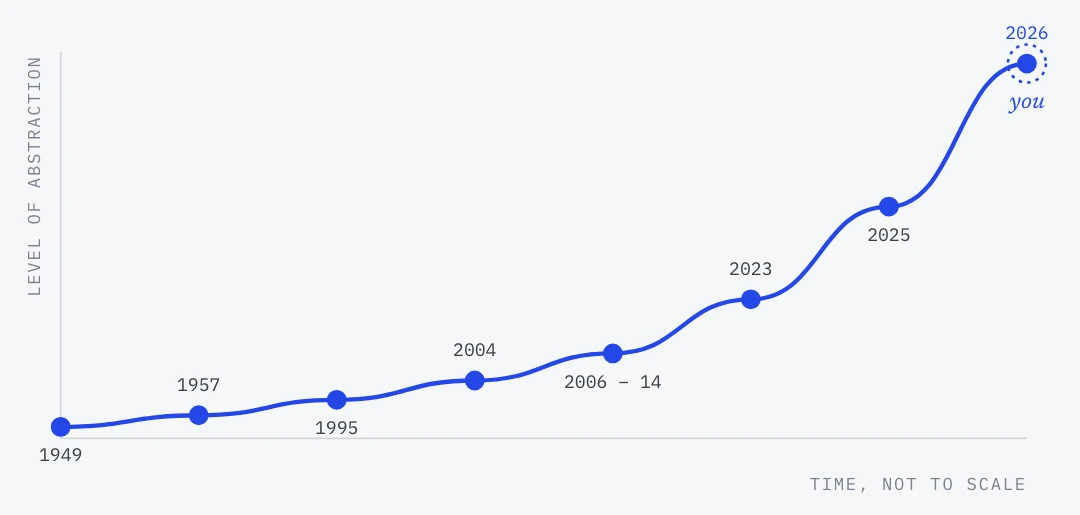
AI agents are the biggest step on that walk yet. Teams can now run fleets of agents that write, test, review, and ship work around the clock.
Ronald's talk on the subject sums it up: "We codified the doing. The deciding, we left to a meeting." In software, the doing has version control, tests, code review, deployment, monitoring, and incident reviews. The deciding still runs on a meeting, a chat thread, a nod, and, only sometimes, a written decision record.
Ronald draws the whole picture as a loop. The name plays on the "agent loop" the AI industry is excited about, in which an agent does some work, tests it, and keeps going until the test passes. "But the decision loop is the loop that is actually important," he says. It has eight steps:
- Know where you are: what has already been decided, and what hasn't
- Decide what to do
- Sign off: someone with the authority says yes
- Shape the decision into a clear specification
- Hand the work to agents
- Check the result
- Release it
- Learn from it, and start again
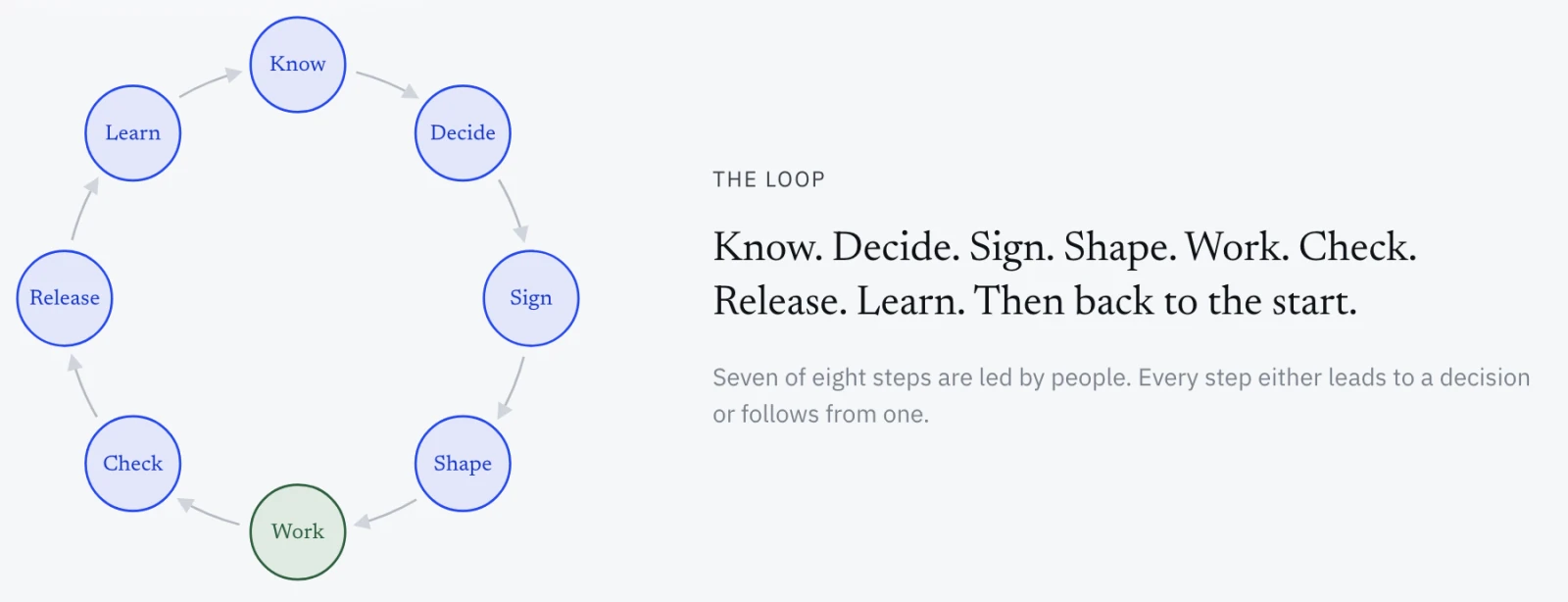
"The interesting thing about this loop is that seven of these eight steps are about people," Ronald says. "The work bit is agents." In his talk, he adds the rule that holds the loop together: "Every step either leads to a decision or follows from one."
That one observation answers one of the loudest claims in our industry: that agents will replace developers, writers, marketers, and everyone else. Agents take on the work step, and they do it fast. The other seven steps still need people who do them well.
Look beyond engineering
Software teams feel this first because agents reached their work first. "Agents write the code and draft the documents and act in the world through APIs and through the same screens we use," Ronald writes. Those include the screens of the marketing, legal, and finance teams. "What is left for people is the same in each: why are we doing this, what does good look like, does this feel right, what did we learn? Deciding."
The loop works for any kind of work, because every function has its own red-or-blue button. Imagine a head of marketing deciding where next quarter's budget goes. The campaign data says one customer segment returns the most per dollar, and the CEO has named a different segment as the company's priority. Agents can model both options overnight, but neither the agents nor the data can settle which one wins. Someone with the authority has to choose, sign, and own the result.
The failures look the same in every function. The marketer asks a model which segment to fund, accepts its answer, and the CEO learns about the choice from the campaign report. No one outside the model ever tests its assumptions. The money moves, and later nobody can say who chose it or why. "It is what happens to any function the day its hands-on work moves to agents and its deciding does not get a system," Ronald writes.
Count the decisions nobody signed
Every piece of agent-driven work is a chain of choices. Which approach? Which trade-off? Is this change small enough to simply make, or big enough to ask about first? "In an agentic process, there are millions of decisions," Robert says. "And the LLM is just making a lot of them without even identifying them as a decision."
The large language model (LLM) behind the agent does follow a rule of thumb for when to stop and check with a human, which it most likely absorbed from its training and its instructions. Your organization never set that threshold, and most people don't know it exists.
Robert's conclusion is that organizations need to sort their decisions into classes and define a procedure for each class. For the decisions that matter most, that includes capturing a formal sign-off from the person who owns them.
Robert and Ronald classify every decision on two axes. The first asks whether a decision can be undone, and at what cost. A trivially reversible decision gets undone the same day, and nobody outside the unit notices. A decision that is reversible with cost takes rework, money, or an awkward correction. An irreversible decision is a statement, signature, filing, or announcement. The second axis asks who outside your unit will feel it: only your own work, one team, the whole company, or people outside the company.
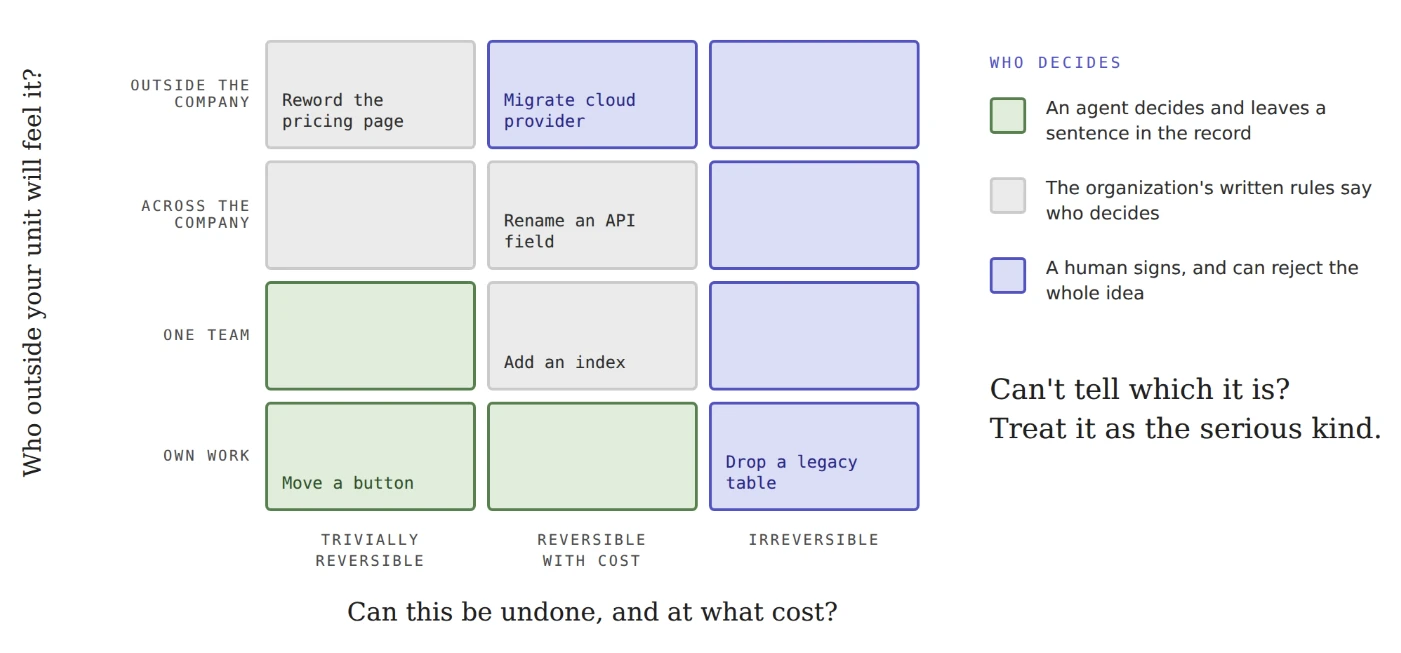
Moving a button sits in the easy, local corner: an agent can decide on its own and leave a sentence in the record. Migrating to a different cloud provider takes months to undo and reaches every team and every customer, so a human signs off and can reject the whole idea. Everything in between follows rules each organization writes down for itself. For the unclear cases, Ronald has one rule: "Can't tell which it is: treat it as the serious kind."
Some decisions always wait for a person, wherever they land on the grid. Ronald lists four kinds: anything that "spends money, cannot be undone, carries legal weight, makes a promise outside the team." Every function makes decisions like these, from a campaign budget to a supplier contract. The rest of the work should not queue behind them. In Ronald's words, "Everything else gets a named agent, a safe default, and a date."
Stop mistaking output for progress
When organizations pour agents into their work without support for the other seven steps, the loop breaks in predictable places. Ronald names four of them.
- Nobody knows what's already known. Past decisions and hard-won expertise live in people's heads, old documents, and chat threads; so teams relitigate them or never find them at all.
- Decisions happen alone. One person sits with an AI assistant and approves whatever comes back, "pretty much saying, yeah, yeah, yeah, okay, that's fine."
- Nobody owns the problem. In Ronald's words, "shaping happens by accident."
- People end up "watching the belt." Skilled people spend their days supervising machine output instead of thinking.
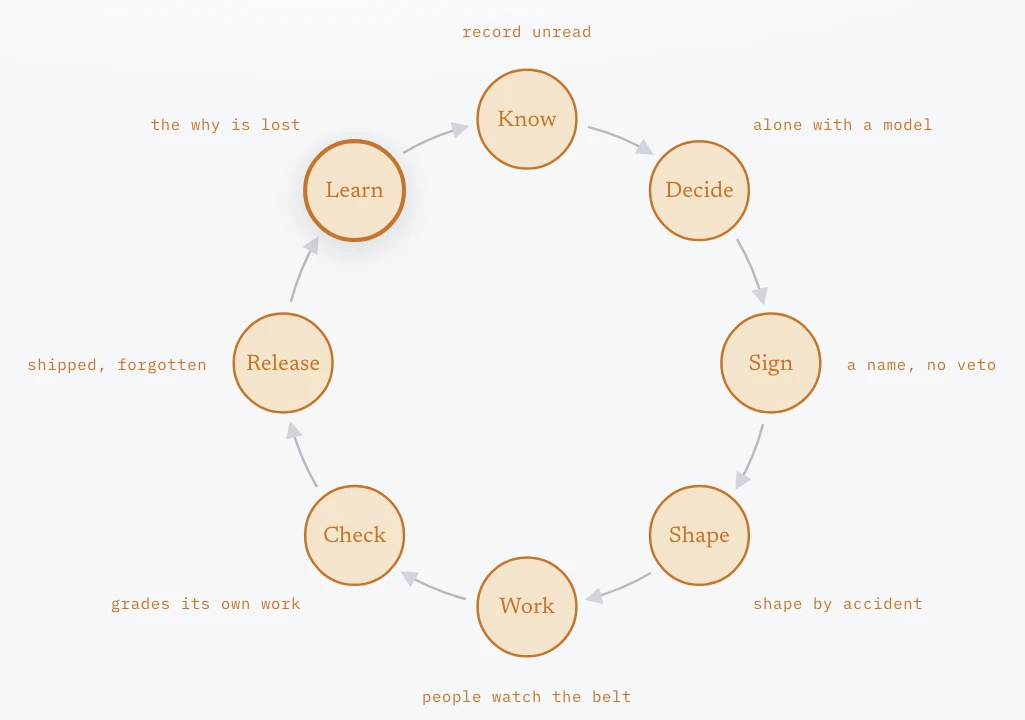
Executives experience these breaks as a frustrating mismatch between activity and results. Teams commit more code and ship more features, and a new line appears in the budget, which Ronald calls "this new cost center of inference." The results don't follow. "It's not actually impacting the bottom line," he says. "You're not seeing the impact you thought you were going to see."
The people doing the work feel it, too. "The teams, instead of feeling happier, are all feeling more exhausted," Ronald says, because much of the job has turned into babysitting machines. "That's actually the problem we need to solve," he adds. "We need to teach people how they get joy from their job again."
Ronald traces all of it back to one habit. "You're not spending the time to think why you're doing those [things]. You're just doing them because now it's easy to do them. You're not thinking why you're doing them, and you're not properly learning from them."
The decision loop shows where the gap sits. Agents took over the work step, so the work moves fast. Knowing what's already been decided, deciding, signing, shaping, checking, releasing, and learning still run at human speed. "So that work thing has sped up a lot," Ronald says. "But everything else is still moving slowly."
Radiology shows this gap between doing more and deciding well.
In 2016, AI pioneer Geoffrey Hinton said the world should stop training radiologists, because neural networks would soon read medical scans better than they could. The technology largely delivered. By Hinton's own account, models now match radiologists on many kinds of scans. He has since called his forecast a "daring and incorrect prediction," though he says he got only the timing wrong. The radiologists are still needed. The UK's Royal College of Radiologists reported a 32% shortfall of consultant radiologists in 2025. Ronald reads the shortage another way: "Turns out, radiologists do more than just reading scans. All the other stuff, the decision loop, is important, and that bit has not scaled, just our ability to read the scan."
The lesson applies to every organization scaling up its use of agents. Running lots of agents in parallel is the easier part. "The problem is in scaling our ability to manage work," Ronald says.
We needed decision management, too
We learned all this the hard way. In September 2026, ironically, it happened to us. We suffered the consequences of slipping up on decision management in house at Spec Kitty.
Robert is accountable for our main product, and he had delegated day-to-day authority to a lead engineer. During a team meeting, Robert stepped out to handle something else; in his absence, the team made a product decision. Robert heard about it later, through a channel, "in the fog of war," while plenty of other things demanded his attention. A few days after that, the change shipped.
"I was horrified," Robert says.
When he traced what went wrong, he found a structural problem: nobody had written down which role each person played in a decision like this one. Many teams use a RACI chart to describe who is Responsible for a piece of work, who is Accountable for it, who must be Consulted, and who only needs to be Informed. "They had treated me as an I in the RACI chart, informed, when I expected to be a C, consulted," Robert says. "I didn't mind delegating my authority. But for a decision above a certain classification level, which we also hadn't formally defined, I would have wanted to go from I to C."
Ronald reads the incident as a classification failure. The change "was not trivial. It's not necessarily easy to undo, and it touched pretty much everything" in the product, which put it at the serious end of both axes, where explicit sign-off is required. "There was nothing there to say, hold on, if you're about to embark on this, you have to have specific sign-off from multiple people, and ensure that they have actually been consulted and they were able to offer an opinion back," he says.
Ronald's rules for the signing step close exactly this gap. As his talk puts it, "a quiet thread is not agreement," and "accountability only means something if the signer can stop the work."
Speed made it worse. With agents doing the work, a decision can move into implementation and out the door before anyone thinks to raise a hand. And as Robert points out, anyone who has ever delegated work has felt some version of this.
Put decisions on the record
Organizations need to know which decisions were made, by whom, and on whose authority, especially when agents make decisions at machine speed. Robert gives four reasons.
- Accountability. "There needs to be clarity that the person who is accountable for a decision is the person who made the decision," Robert says. "Otherwise, it's not a decision, it's a breach of authority."
- Regulation. Many regulated industries already require an auditable trail of who decided what.
- Diagnosis. "Every organization who's going to accelerate their operations by pouring gasoline onto the AI fire is going to end up in the situation where it goes off the rails at some point in some way," Robert says. "And they're going to want to understand how. And why." Without a record of the decisions, they can't.
- Learning. Software teams keep architectural decision records to explain why a system looks the way it does, and the same habit works in any field. When an organization captures its decisions clearly, the AI doing the work can learn from them and make better calls next time.
Every serious organization runs a system of record for its customers and another for its money. "You don't actually have a system of record for maybe the most interesting thing in an organization," Ronald says, "which is your knowledge, your decisions, and why you're doing things." He has a name for the missing piece. "The CRM is the record of customers. The ERP is the record of money. This is the record of judgment."
That gap used to be survivable. Decisions moved at the speed of meetings, and the people who made them were usually around to explain. Agents change the tempo: the knowledge that informs a decision, the rules that govern how work gets done, and the decisions themselves all need a home that people and agents can consult.
"You need to capture the knowledge of your experts," Ronald says, so that it can answer questions "when they're not in the room," whether the question comes from a colleague or from an agent.
Some of the hardest problems here are still open, for us and for everyone else in the field. Nobody can yet prove who signed a decision, check an agent's authority at the moment it acts, hand a decision's full context to someone who wasn't in the room, or say which decisions should expire. Our own loop has so far only run inside a single team. Ronald calls these open problems the roadmap, "because whoever solves them owns the loop."
What we believe
Robert's red-or-blue story holds the future we want to build. The button question brought the developer, the product owner, and the CEO into the same conversation, each looking at the problem through a different lens. "The CEO needs to know what's the top-line value of this, and the CPO needs to know what's the customer impact of this," Robert says. "Those are all different sets of context for the same set of underlying information."
We think the next era of work looks like that room. Agents take on more and more of the doing. People own the knowing, the deciding, the signing, the shaping, the checking, and the learning. The organizations that thrive will treat their decisions as seriously as they treat their customers and their cash.
Ronald's version of the loop comes with seven working rules that apply in any function:
- Start from what we already decided. Read the record before opening a question. If the team has already answered it, the answer stands until a person changes it.
- Decide in the open. Make decisions where the team can read along, and write them down somewhere permanent.
- One person signs off. Name the signer before the work starts, and give them the power to stop it.
- People set the shape, and agents fill it in. An agent acts only with the authority a person gave it, and it can hand on only a narrower version.
- Every piece of work serves a decision. Either it carries out something we decided, or it helps us decide something we haven't. If you can't say which, stop.
- Check the work before you accept it. A different reader checks the result. For anything important, write down what you expect before you read what the agent recommends.
- Record it, release it, and go back. Write down what you expect to see, then look again.
At Spec Kitty, we are building a decision layer for autonomous software delivery. At its center sits the record of judgment: the place where a decision is made once, signed by a person, carried out by agents, checked by something other than its author, and judged later by what actually happened.
Ronald measures value as "a signed decision that held: we decided X, expected Y, observed Y." In his words, "Models will be commoditized; an organization's judgment with its outcomes will not."
Underneath all of this sits one conviction. "I think people want to hear why they matter," Ronald says. "We're doing this because we believe people matter."
Decide once. Agents do the rest. Then see what actually happened.
Start with the free, open source Spec Kitty CLI on GitHub.
Bring your whole team along with our full-day rollout workshop.
Sources
- Ronald Ashri, "Coding Agents at Scale", webinar, September 22, 2026.
- The Royal College of Radiologists, 2025 Clinical Radiology Workforce Census Report.
- Eric Topol, "Geoffrey Hinton: Large Language Models in Medicine", Ground Truths.
- Joshua Gans, eyewitness account of Hinton's 2016 remark, Substack.