1 · Know
Contact usBrain Kitty
Each person curates their own knowledge graph of the standards, runbooks, rules and decisions they own. Answers cite it, and people approve every change.
See Brain KittyDecision layer for autonomous software delivery
Coding agents now make thousands of small decisions at machine speed. Spec Kitty makes sure they build with what your experts know and what your team decided.
As of 8 Oct 2026. Sources: GitHub, PyPI.
The problem
Every real system is thousands of red-or-blue calls, usually made by whoever is at the keyboard, and now by AI agents at machine speed. Deciding them well is still a human job, and most teams have no system for it.
Problem 1
Your standards and past decisions live in people's heads and in wikis agents never read. The same ticket comes out differently depending on who picks it up.
Problem 2
When behavior changes, nobody can show who decided it, why, or what it was checked against. The reasoning stayed in a chat window.
Problem 3
The agent that wrote the change is the one that says it's fine. Review becomes a rubber stamp at machine speed.
What Spec Kitty does
Start with the free CLI today; add your team's knowledge when you are ready.
1 · Know
Contact usEach person curates their own knowledge graph of the standards, runbooks, rules and decisions they own. Answers cite it, and people approve every change.
See Brain Kitty2 · Decide
Early accessThe hosted team product. It collects the team's Brain Kitty graphs so the team decides together what applies, then serves it to Build Kitty over MCP, the standard way coding agents load outside knowledge.
Request early access3 · Build
Free, MITThe free Spec Kitty CLI. Agents spec, plan, build and review in the coding agent you already use, with the knowledge Team Kitty serves over MCP and checks an agent can't skip.
See how it worksWork solo for free. Bring in Team Kitty when you invite your team.
Brain Kitty
Each person curates their own Brain Kitty: a knowledge graph of the standards, runbooks, rules and decisions they own. Every answer cites its source.
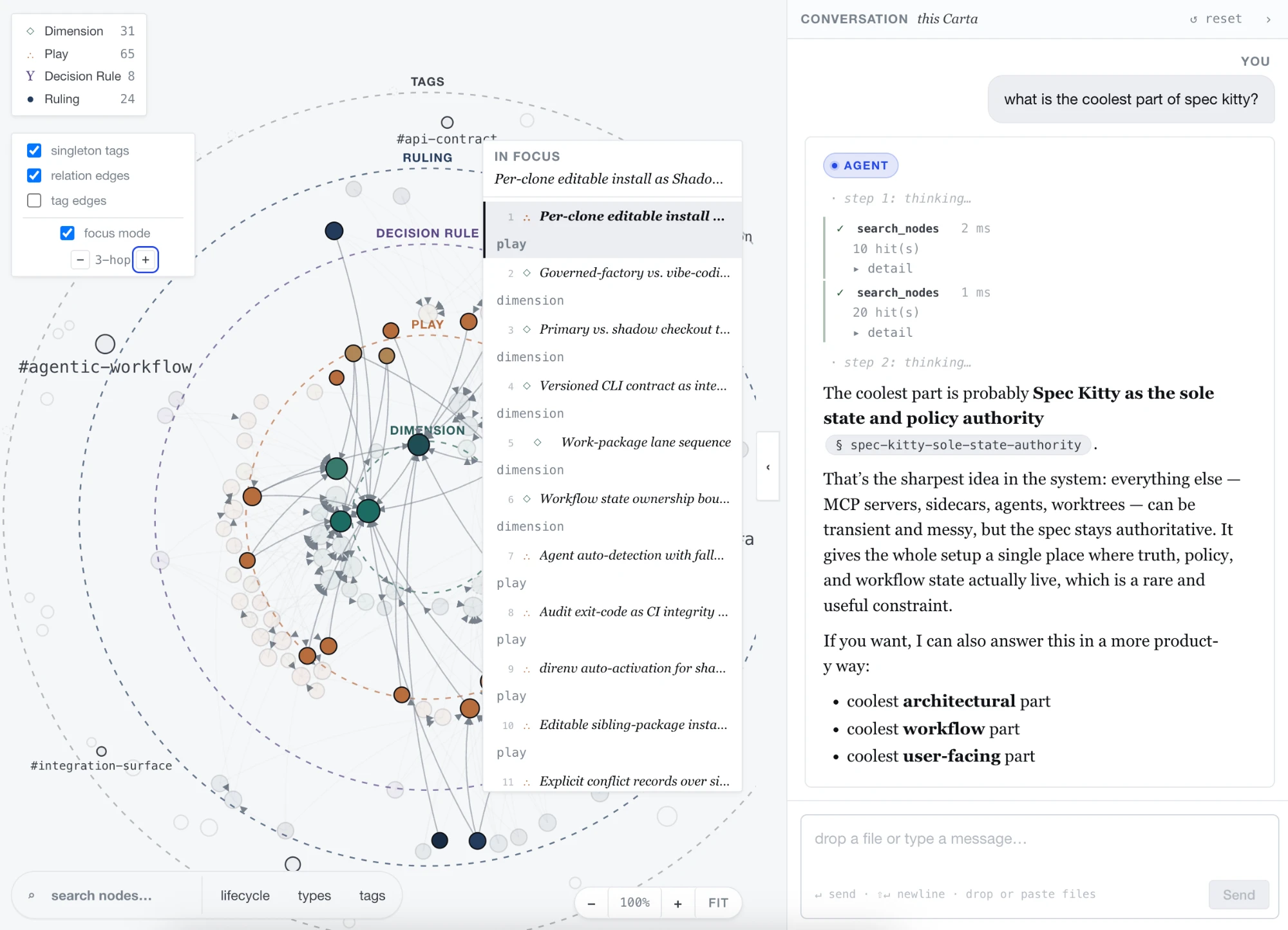
How it works
01
The standards, runbooks, rules and decisions you own, in your own knowledge graph.
People: You decide what goes in and approve every change.
Agents: Brain Kitty proposes updates; it never changes what was decided on its own.
02
Team Kitty brings everyone's Brain Kitty together and serves it to every coding agent over MCP.
People: The team decides together what applies to its work.
Agents: Agents load only what the team chose, and only the slice each step needs.
03
Build Kitty asks what to build and how, with your team's knowledge loaded.
People: You answer, then review and edit the spec before any code.
Agents: Agents write the spec, plan and work packages.
04
Each work package runs in its own git worktree, so agents don't collide.
People: You schedule the work packages like any other work.
Agents: Agents build, each in its own worktree.
05
The work is checked against the spec and your team's knowledge before it lands.
People: You merge. Nothing lands without a person.
Agents: A reviewer that isn't the author checks the work.
From a first workshop
“A ticket our own engineers had sized at ten days went out the door in about five hours, during the workshop, on our first time using it.”
Who it's for
Engineering executives
What your experts know reaches every team's agents, and leadership can see what was decided and why.
Brain Kitty + Services
Engineering managers
One way of working for the whole team: same standards, same review, whoever picks up the ticket.
Team Kitty + CLI
Product and program managers
Product decisions written down, cited every time, and built by every agent.
Brain Kitty + Team Kitty
Developers
Free. Your agent asks first, works in its own worktree, and gets a second reviewer.
Build Kitty (free CLI)
Use case
The free CLI turns a legacy rewrite into small, specced, reviewed steps your team can schedule.
Legacy modernization
Start free with the CLI, or book a demo. Our rollout packages leave working software behind.